Lima, Peru
Apr 24, 2013
HENSE
Lima, Peru
2013
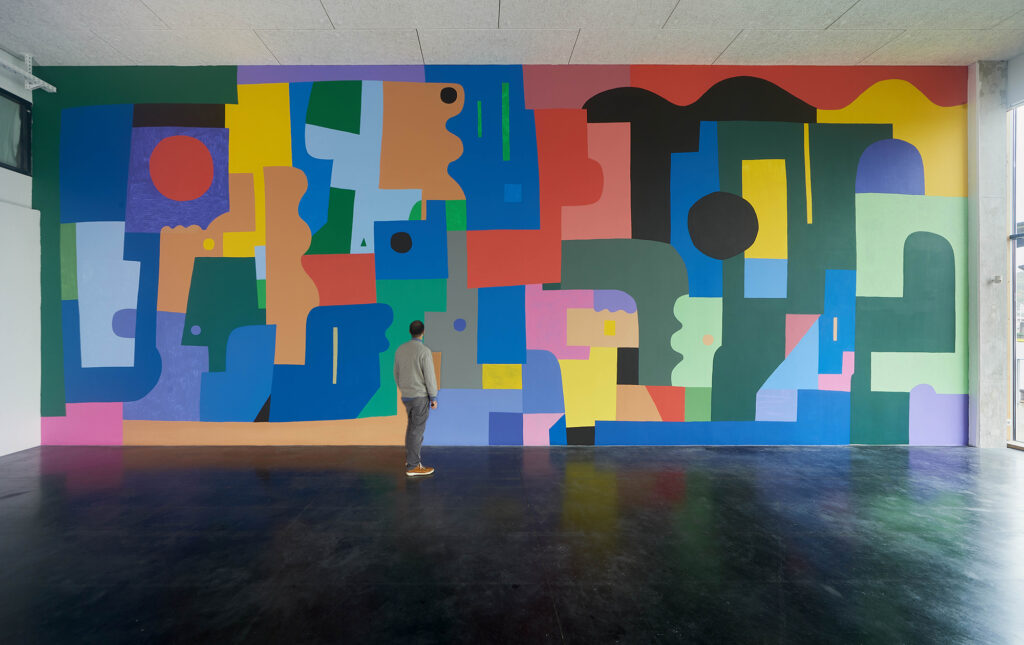
We just finished up a large exterior installation in Lima, Peru. This is my tallest work to date measuring 137 feet tall and 170 feet wide.
The project was organized by Morbo Gallery and funded by the ISIL Institute in MiraFlores, Lima.
I worked with my head assistant and a crew of 10 professional painters over the course of a month to complete the work.
With all my exterior projects, I rarely use a preconceived sketch or concept to go off of. In this case, I presented a few rough concepts to the school to express my vision for the building. However, I always like to leave some room for creative freedom and spontaneity while working. This project was challenging because of the scale. Every shape and mark that we made on the wall had to be massive to be seen from a great distance. I also wanted to leave smaller, details that would be seen by viewers close to the work. In this case most of my painting crew were local to Lima and spoke little to no English and I speak very little Spanish so it was challenging to communicate with them in the beginning of the project. After a month of working everyday with them we managed to be able to understand each other. I´m very grateful for that experience and I learned a lot from them and hope that they were inspired in some way by assisting in the process of the artwork.
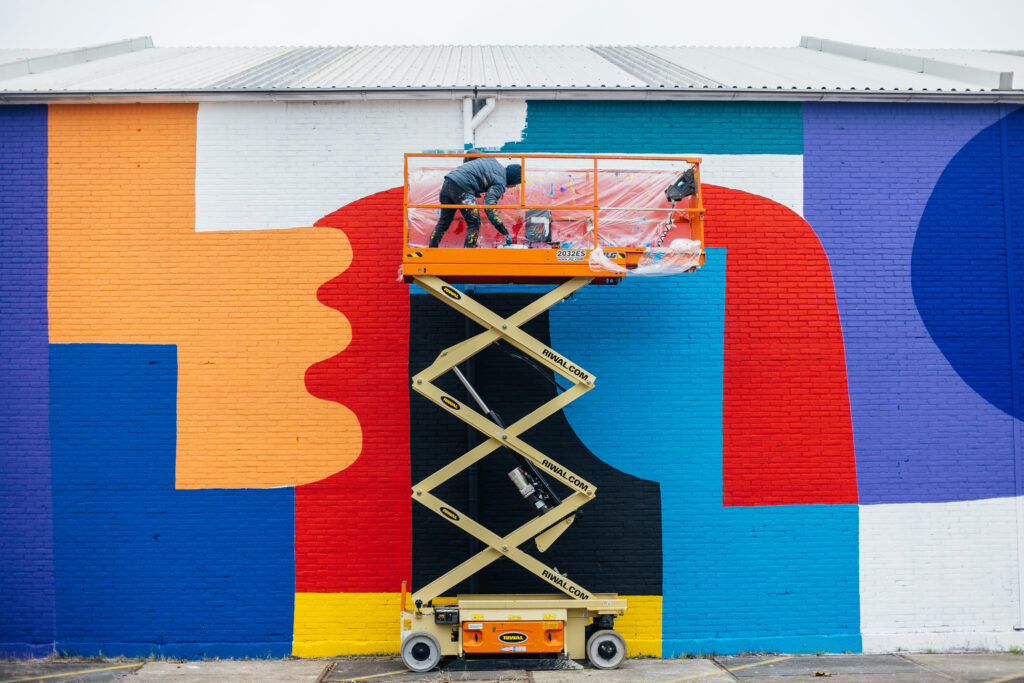
We used over 200 gallons of exterior latex paint and a small amount of aerosol on this work. Most of the tools we used were rollers of various sizes, a paint sprayer, brushes, and homemade tools. One thing I feel is important when working on this scale is the improvisational use of tools to create the marks and shapes. In order to reach heights and lengths I had to attach brushes to extension poles to paint in hard to reach areas. We used strings and ropes to create circles and lines that needed to be accurate. However, most gestures and shapes were created freehand. I always push to keep a loose, painterly feel at a large scale. All my work is purely abstract and non representational.
These works are inspired by the architecture and context of the structure. In this case I wanted to use very bright colors that would pop against the sky and next to other near by architecture in Lima. This piece has many layers in it. some of which we covered completely. It’s important to me that the work has a very layered and built up look. I’m never afraid to destroy the image at any given time if it means I have to in order to achieve progression in the work.
I’m always wanting to challenge myself and the viewer in regards to painting and what that can be.
Photo Credits: Christian Rinke, Os Villavicencio, Gino Moreno, Jules Bay, Elard Robles and HENSE.
Special thanks to: Jules Bay, Taylor Means, Morbo Gallery, ISIL Institute, Luar Zeid, Panorama, Angel, Paul, Pedro, Alex, Miguel, Jaime, Mayo, William, Christian Rinke, Gino Moreno, Os Villavicencio, Carlos Benvenuto, Candice House, Elard Robles. For all the hard work and making this project come to fruition.
Continue »
Fay Gold Gallery & Westside Cultural Arts Center
Feb 25, 2013
Commissioned full building murals for the new Fay Gold Gallery and Westside Cultural Arts Center in Midtown West Atlanta.
Continue »Huffington Post
Jan 24, 2013
“We can certainly appreciate the beauty in the classical aesthetic that so often characterizes sites of religious observance. But sometimes even traditional venues need a radical makeover.
Graffiti artist Hense did just that to a former church in Washington D.C.‘s up-and-coming arts district. The artist got to work with the help of a small crew, using rollers, brushes, spray paint, inks, acrylics, mops, enamels and paint sprayers to cover every inch of the edifice in popping hues. After several weeks, the white church was transformed into a rainbow splattered objet d’art. In an e-mail to the Huffington Post, Hense described the reaction to the extreme makeover as overwhelmingly positive, with a few exceptions. “There were a few people who thought of it as desecrating on the church,” he wrote. “Although once it was explained that it was a work in progress and had positive thought behind the gestures, colors and marks, they generally understood.”
Check out the church’s metamorphosis below and let us know your thoughts in the comments section.”